Demagnetizing and Magnetizing Apparatus STEM Lab
Product Code : SCL-M-12567
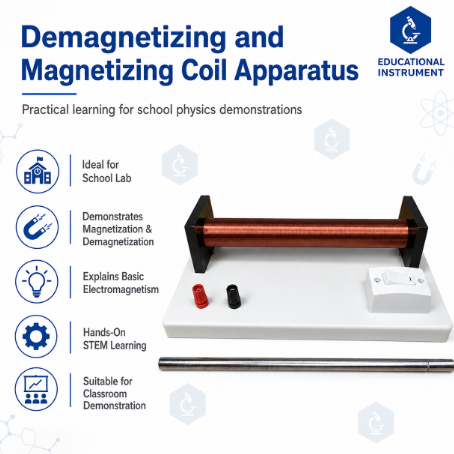
The Demagnetizing and Magnetizing Apparatus – STEM Lab by Educational Instruments India is a foundational physics laboratory device engineered to explicitly demonstrate the structural principles of ferromagnetism, magnetic domain alignment, and magnetic hysteresis. This industrial-grade apparatus provides physics classrooms, research centers, and STEM institutions with a safe, accurate tool to change the structural magnetic properties of metals on demand.
The system relies on a high-density, multi-turn solenoid coil designed to tolerate both direct current (DC) and alternating current (AC) cycles. When a ferromagnetic specimen—such as iron, steel, or nickel—is placed inside the core chamber, exposure to a unidirectional DC magnetic field aligns its internal microscopic magnetic domains, magnetizing the specimen. Conversely, passing AC power through the coil subjects the material to a rapidly reversing magnetic field, which randomizes the domains and strips the material of residual magnetism.
Key Educational Deliverables & Concept Coverage
Magnetic Domain Theory: Visualizing how random atomic dipoles become structurally ordered under localized external fields.
Magnetic Retentivity & Coercivity: Measuring and evaluating why hard steel retains permanent magnetization while soft iron returns to a neutral state.
Alternating Current Demagnetization: Investigating the structural mechanics of using a decaying alternating magnetic flux to clear residual magnetism.
Industrial Applied Science: Exploring real-world workflows like tool demagnetization, magnetic storage drive clearing, and CRT monitor degaussing.
Technical Product Specifications
|
Brand Name |
Educational Instruments India |
|
Target Group |
High School Physics Labs, University Engineering Classes, and Advanced STEM Workshops |
|
Curriculum Standards |
Aligned with CBSE Practicals, ICSE, International A-Levels, IB Physics, and Global Higher Education Laboratory Guidelines |
|
Solenoid Coil Construction |
Heavy-gauge enameled copper induction wire, tightly wrapped around an insulated, hollow polymer cylinder |
|
Internal Cylinder Dimensions |
Length: 250mm | Internal Diameter: 35mm (Accommodates large specimen rods safely) |
|
Electrical Input Options |
• DC Mode (Magnetizing): 6V to 12V DC via specialized lab power supply |
|
Current Safety Threshold |
Maximum continuous load of 6 Amperes (Fitted with auto-reset thermal fuse protections) |
|
Baseboard Mount |
Sturdy, non-slip, scratch-resistant laminated baseplate with isolated structural support brackets |
|
Included Test Specimen Kit |
• 1x Soft Iron Sample Rod (High retentivity profile exploration) |
How to Use It: Step-by-Step Guided Experiments
Experiment 1: Transforming Raw Steel into a Permanent Magnet
Verify that the carbon steel test bar is completely unmagnetized by bringing it close to the testing compass needle. No deflection should occur.
Slide the steel bar directly into the center hollow opening of the solenoid coil.
Connect the 4mm terminal jacks of the apparatus to the DC output ports of a regulated lab power supply, configured to 12V DC.
Depress the momentary power switch on the apparatus for 5 to 10 seconds, then release it. Turn off the power supply.
Remove the steel bar. Bring it near the testing compass to observe strong angular deflection, confirming the creation of a stable permanent magnet.
Experiment 2: Complete Demagnetization (Degaussing Process)
Keep the newly magnetized steel bar inside the solenoid core.
Disconnect the DC lines and attach the apparatus terminals to the AC output ports of a step-down laboratory transformer, set to 12V AC.
Turn on the AC current. While the alternating field is actively running inside the cylinder, slowly and smoothly extract the steel bar out along the axial center line of the coil until it is at least 1 meter away from the apparatus.
Turn off the AC transformer power supply. Bring the bar close to the testing compass to observe zero deflection, proving that the reversing AC vector field successfully randomized the internal magnetic domains.
Safety and Operational Guidelines:
Thermal Threshold Management: Due to low internal resistance, running high current loops through the enameled wires produces high Joule heating. Do not keep the power circuit locked closed for longer than 30 consecutive seconds.
AC Sequence Discipline: Always pull the test material completely away from the running coil before shutting down the AC transformer. If you cut the AC power while the bar rests inside, the cycle may freeze on a peak vector, leaving the specimen heavily magnetized.
Frequently Asked Questions (FAQs)
Q1: Can I connect this apparatus directly into a standard 230V wall socket?
A: Absolutely not. This apparatus is designed exclusively for low-voltage educational environments (6V - 12V AC/DC). Connecting it directly to high-voltage mains will instantly destroy the induction insulation and presents a dangerous electrical hazard. Always run the system through an approved benchtop step-down power supply.
Q2: Why does the steel bar require a slow extraction method to demagnetize?
A: Drawing the bar away slowly exposes its internal domains to a gradually decaying alternating magnetic field. This cyclic reduction steadily shrinks the material's hysteresis loop down to zero, ensuring complete structural demagnetization.
Q3: What makes this kit safer than improvised laboratory electromagnets?
A: The Educational Instruments India apparatus is built with heavy, heat-resistant polymer cylinders, fully insulated connection terminals, and a secure non-magnetic baseline structure. It prevents structural short-circuits and features predictable impedance profiles designed to safeguard school laboratory electrical networks.