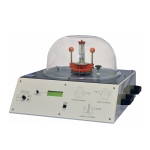
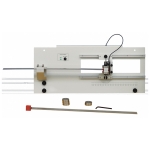
Quick Answer: The Hertzian Contact Apparatus forces two curved pads together with a hand-operated hydraulic pump and cylinder so students can see and measure the contact shape that forms between them. The upper pad has compound radii and the lower pad a simple radius.
Last updated: October 2026
Key Features
Two pads with curved contact surfaces: compound radii above, simple radius below
Lower pad rotates, with a pointer showing the angle
Hand-operated hydraulic pump and cylinder press the pads together
Locknuts on the pump threads limit the maximum pressure
Transparent scale supplied to measure the contact shape and angle
Technical Specifications
Specification
Value
Upper pad
Compound radii
Lower pad
Simple radius, rotatable with angle pointer
Loading
Hand-operated hydraulic pump and cylinder
Pressure limit
Locknuts on pump threads
Measurement
Transparent scale
About This Product
Turning the lower pad changes the relative curvature of the two surfaces, so the contact zone changes between a circle and an ellipse. Students measure the contact shape and angle with the transparent scale and compare their results with Hertzian contact theory. Schools, colleges and institutes in Egypt, Vanuatu, Sudan, Niger and Lithuania can order the Hertzian Contact Apparatus from Educational Instrument.
Frequently Asked Questions
Why does the contact shape change?
The contact zone is circular or elliptical depending on the relative angular position of the two pads. Rotating the lower pad changes that angle, which the pointer shows.