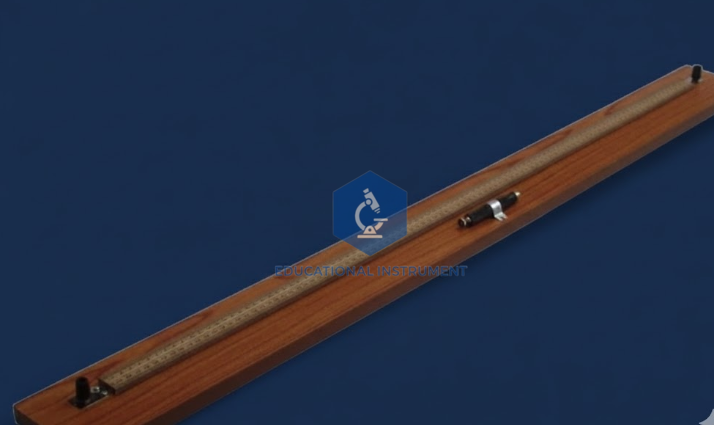
Quick Answer: The Potentiometer with Jockey Pencil is a wire potentiometer with constantan or manganin wires stretched over a polished hardwood base, made in 4-wire and 10-wire versions. Readings are taken with a spring-loaded pencil jockey against a cm/mm scale.
Last updated: October 2026
Key Features
4-wire or 10-wire versions
Constantan or manganin wire with low thermal EMF and high resistivity
Seasoned hardwood base with a polished protective finish
Spring-loaded pencil jockey with non-corrosive metal contact
Linear scale in cm and mm, readable in both directions
Heavy-duty 4 mm brass sockets
Technical Specifications
Specification
Value
Wires
4-wire / 10-wire
Wire material
Constantan / Manganin
Base
Seasoned hardwood, polished finish
Jockey
Spring-loaded pencil type
Scale
Linear, cm/mm
Terminals
4 mm brass sockets
HS code
9027.80
About This Product
A wire potentiometer compares potential differences without drawing current from the cell under test, so it is used to compare the EMFs of two cells, find the internal resistance of a cell and measure small voltages. Students slide the pencil jockey along the wire to find the balance point and read its length from the scale. The Potentiometer with Jockey Pencil can be supplied on export terms to Nicaragua, Côte d'Ivoire, New Zealand, United Kingdom and Niger.
Frequently Asked Questions
What is the jockey on the Potentiometer with Jockey Pencil?
It is a spring-loaded pencil-type jockey with a non-corrosive metal contact, pressed onto the wire to find the balance point.