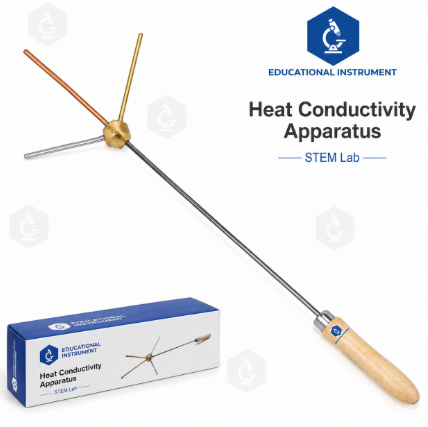
Quick Answer: The Heat Conductivity Apparatus, also called Ingenhousz’s apparatus, has four metal rods of matched size fixed to a central heating hub. Wax melting along each rod shows which metal conducts heat fastest.
Last updated: October 2026
Key Features
Four metal rods attached to one central heating hub
Rods matched in size: about 150 mm long and 5 mm in diameter
Insulated handle for mounting on a ring stand with a clamp
Wax coating or wax rings along the rods show how far heat has travelled
Demonstrates Fourier’s law of heat conduction
Technical Specifications
Specification
Value
Type
Ingenhousz’s apparatus
Rods
4, uniformly matched
Rod size
Length ~150 mm, diameter ~5 mm
Principle
Fourier’s law of heat conduction, thermal conductivity
Mounting
Insulated handle, clamps to a ring stand
About This Product
With every rod coated in a thin layer of paraffin wax and heat applied under the hub, students watch the wax melt furthest and fastest on copper, then aluminium, brass and iron. Timing how long the melt takes to reach a marked distance lets them rank the metals, and because length and diameter are the same for every rod, the material is the only variable.
Frequently Asked Questions
Why must the rods of the Heat Conductivity Apparatus be the same size?
Rate of heat transfer depends on cross-sectional area and length. With identical rods, the only variable left is the metal itself, which keeps the test fair.
Which rod melts its wax first?
Copper, followed by aluminium, brass and finally iron.