
Newton’s Ring Lens Set
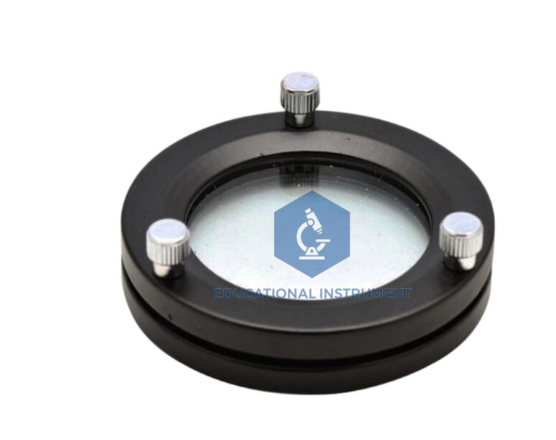
Product Code : SCL-OS-11863
The Newton’s Ring Lens Set is engineered for the precise measurement of light wavelengths and the refractive index of transparent thin films via interferometry. It resolves the requirement for high-stability monochromatic fringe generation in advanced wave optics and metrology curricula.
Technical Specifications
|
Tender Specification |
OEM Technical Detail |
|
Material Grade |
Optically Worked Crown Glass (Grade A) |
|
Optical Configuration |
Plano-Convex Lens & Optically Flat Glass Plate |
|
Housing/Frame |
Ruggedized Metal Frame with Three-Point Tension Adjustment |
|
Dimensions |
50mm to 60mm Diameter (Standardized Institutional Sizing) |
|
Surface Regularity |
Calibrated for Sharp Interference Fringe Resolution |
|
HS Code |
9001.90.00 (Unmounted Optical Elements/Sets) |
Key Pedagogical Outcomes (Bloom’s Taxonomy)
Feature: Large Radius of Curvature (Plano-Convex). Outcome: Facilitates the generation of expanded concentric interference patterns, supporting the Analysis of Newton’s Rings under monochromatic light sources.
Feature: Integrated Three-Point Pressure Adjustment. Outcome: Allows students to manipulate fringe density and center-point contact, aiding in the Evaluation of air-film thickness and wave phase shifts.
Feature: Optically Worked Flat Base Plate. Outcome: Minimizes parasitic reflections and wave distortion, enabling the Application of mathematical models to determine the wavelength of sodium light.
Feature: High-Transmittance Substrate. Outcome: Resolves high-contrast dark and bright fringes, essential for the Identification of Newton's Ring diameters in precision metrology modules.
International Logistics & Compliance
To ensure the preservation of optical flatness and prevent surface abrasion during transcontinental transit, all sets are secured in export-grade seaworthy crating (ISPM-15 compliant). Documentation provided for international procurement includes the Manufacturer’s Authorization Form (MAF), Batch-Specific Inspection Reports, and User Manuals in English. The Educational Instrument features a tropicalized design, verified for operational stability in environments up to 45°C and 90% humidity, successfully mitigating the risk of glass "fogging" or metallic oxidation in non-temperate climates.
Why Source from the OEM?
Procuring directly from the OEM ensures total vertical integration, eliminating the quality variance typical of third-party trading entities. Our facility utilizes in-house optical grinding and polishing to achieve the extreme radii of curvature required for accurate interferometric data. Every unit is batch-tested for uniformity and fringe clarity using laser-based quality control prior to dispatch. Direct sourcing guarantees factory-direct spares availability and provides a clear channel for technical accountability for large-scale institutional tenders and ministerial-level educational contracts.

.png)