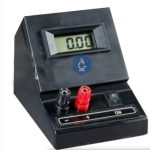
Photoresistor on base

Product Code : SCL-MBAVTOB-12944
The Photoresistor on Base from Educational Instrument is designed for practical experiments on light-sensitive resistance and sensor response. The catalogue identifies this model as product code 5133 and states that its resistance varies as a function of the light received.
This photoresistor module is mounted on a compact educational base with catalogue dimensions of 103 × 54 × 30 mm. It can be used with compatible physics lab equipment, electronics lab equipment, educational laboratory equipment, and school lab equipment.
Key Features
Light-dependent resistance: Demonstrates how resistance varies according to received light intensity.
Base-mounted format: Provides a stable and visible module for classroom electronics experiments.
Compact laboratory size: Catalogue dimensions are 103 × 54 × 30 mm.
Useful for sensor demonstrations: Helps students understand photoresistors, LDRs, and light-sensing circuits.
Supports electronics learning: Suitable for lessons on resistance, illumination, transducers, and automatic control circuits.
Compatible circuit use: Can be used with meters, power supplies, resistors, switches, connecting leads, and modular circuit components.
Reusable teaching accessory: Suitable for repeated supervised use in school physics and electronics laboratories.
Technical Specifications
Included ComponentsBase-mounted photoresistor module
|
Specification |
Detail |
|
Product Name |
Photoresistor on Base |
|
Brand |
Educational Instrument |
|
Product Code |
5133 |
|
Product Category |
Physics Lab Equipment / Light-Sensitive Electronics Component |
|
Function |
Resistance varies as a function of the light received |
|
Dimensions |
103 × 54 × 30 mm |
|
Sensor Type |
Photoresistor / light-dependent resistor |
What's Included in the Kit
1 Photoresistor on Base
Base with connection terminals
Photoresistor / LDR element
Connecting leads
User instruction sheet or experiment guide
Applications / Uses
Demonstrating how photoresistor resistance changes with light intensity.
Studying LDR behaviour using a multimeter or ohmmeter.
Building simple light-sensing circuits in electronics lessons.
Showing the working principle of automatic lighting and light-activated switches.
Teaching sensor, transducer, resistance, and illumination concepts.
Supporting STEM activities on electricity, measurement, and environmental sensing.
How to Use the Photoresistor on Base
Place the Photoresistor on Base on a clean, dry laboratory bench.
Connect the terminals to a multimeter, ohmmeter, or suitable low-voltage circuit.
Record the resistance reading under normal room lighting.
Cover the photoresistor and observe the change in resistance in low-light conditions.
Expose the photoresistor to a controlled light source and record the new resistance value.
Switch off the circuit before changing connections or storing the apparatus.
Safety note: Use only within the confirmed electrical rating. Do not connect the photoresistor directly to unsuitable power sources, and avoid excessive heat from strong lamps or direct flame exposure.
Care & Maintenance
Keep the photoresistor surface clean, dry, and free from dust for consistent readings.
Do not scratch, bend, overheat, or press the sensor element during handling.
Inspect the base, terminals, and sensor element for damage before use.
Store the unit in a dry laboratory cabinet away from moisture, heat, and chemicals.
Why Choose Educational Instrument
Educational Instrument supplies laboratory equipment, science kits, STEM models, didactic models, and experiment setups for schools, colleges, and technical training institutions. The brand supports practical learning across physics, chemistry, biology, mathematics, electronics, and technical education.
For light-sensor demonstration components such as the Photoresistor on Base, Educational Instrument focuses on classroom usability, clear practical demonstration, and compatibility with educational circuit systems. Buyers should confirm the final dark resistance, light resistance, terminal type, and electrical rating before institutional purchase.
Frequently Asked Questions
What is the Photoresistor on Base used for?
The Photoresistor on Base is used to demonstrate how resistance changes with light intensity. It is useful for school physics, electronics, and sensor-based circuit experiments.
Is a photoresistor the same as an LDR?
Yes, a photoresistor is commonly called an LDR, or light-dependent resistor. Its resistance changes according to the amount of light falling on the sensor.
What are the dimensions of the Photoresistor on Base?
The catalogue dimensions are 103 × 54 × 30 mm. This compact base format is suitable for modular classroom electronics setups.
Can this product be used in school electronics labs?
Yes, it is suitable for supervised school physics and electronics laboratories. Students can use it with meters and low-voltage circuits under instructor guidance.
What resistance values does this photoresistor have?
The dark resistance and light resistance values are not confirmed in the available catalogue detail.
Does this product have confirmed certification?
For compatible sensor modules and classroom circuit apparatus, explore Educational Instrument’s electronics lab equipment range.
.png)
.png)