Tuning Fork with Resonance Box STEM Lab

Tuning Fork with Resonance Box  STEM Lab
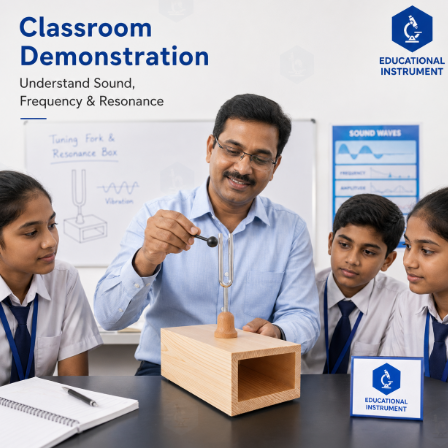
Product Code : SCL-ES-12548

Unlock the foundational mechanics of acoustics and wave physics with the high-caliber Tuning Fork with Resonance Box STEM Lab Kit, precision-manufactured by Educational Instrument India. Engineered specifically to bridge abstract textbook wave equations with interactive physical realities, this classic scientific apparatus serves as an essential demonstration framework for secondary schools, higher educational institutions, and STEM exploration centers globally.

The core system consists of a premium, grade-calibrated tuning fork forged from specialized elastic steel alloy. This high-tensile metal formulation guarantees a stable, uncompromised frequency output over extended operational lifespans. The tuning fork is anchored directly via a solid steel stem into a finely crafted acoustic resonance box. Built using hand-selected, seasoned resonance-grade wood, the box features a hollow core structure that is sealed at one end and open at the other. When the tuning fork is excited using the included rubber-headed striking mallet, its vibrational mechanical energy transfers seamlessly down the stem and into the wood, inducing structural vibrations inside the internal air column. This column functions as a specialized quarter-wavelength acoustic resonator, drastically increasing the sound output and projecting a loud, clear, audible sine wave throughout large lecture halls.

Perfect for investigating periodic motion, mechanical wave interference, sound velocity calculations, and sympathetic harmonic transfer, this apparatus provides the rigorous performance metrics needed to establish true academic trust. Its open, touch-accessible design ensures students can interact directly with the hardware, observe compression-rarefaction wave transitions, and safely capture accurate quantitative laboratory data.

Core Pedagogical and Technical Key Features:

Precision Frequency Calibration: Each tuning fork is factory-machined and electronically laser-etched to deliver standard, stable frequency outputs (such as 440 Hz or 256 Hz) with minimal drift.

Acoustic Impedance Matching Optimization: The hardwood box is mathematically optimized to match the acoustic properties of the fork tines, transforming faint, localized mechanical vibration into powerful, amplified audible air waves.

Interchangeable Mounting System: Features a standard threaded socket base allowing easy swap-outs of tuning forks to explore different sound pitches, harmonics, and beat frequencies.

Heavy-Duty Resonant Chamber: Crafted with tight-grained seasoned hardwood and a smooth protective coat to minimize acoustic dampening, splitting, or humidity warping over decades of storage.

Complete Turnkey STEM Kit: Arrives safely packaged with a calibrated tuning fork, an acoustic-matched resonance chamber, and a weighted rubber striking mallet to begin experiments immediately.

  1. Product Specifications

Parameter Matrix

Technical Engineering Specification Details

Brand Name

Educational Instrument India

Product Classification

Acoustics, Mechanical Vibrations & Wave Dynamics STEM Apparatus

Calibrated Frequencies Available

Standard 440 Hz (A4 Concert Pitch) / 256 Hz (Scientific C Pitch)

Tuning Fork Metallurgy

High-tensile, chrome-plated hardened elastic steel or premium aluminum alloy

Resonance Chamber Framework

Premium seasoned tone-wood with a low-dampening interior shell and clear exterior finish

Resonator Design Type

Quarter-Wavelength Acoustic Tube, closed at one end, open at opposite profile

Excitation Tool

Weighted rubber-headed mallet with an ergonomic wood or polymer handle

Mounting Interface

Secure screw-thread or press-fit vertical stem receiver

Dimensions (L x W x H)

Approx. 180 mm x 95 mm x 60 mm (Box dimensions, excluding fork height)

Net Kit Weight

Approx. 650 grams (Optimal mass for rich structural resonance transmission)

  1. How to Use the Tuning Fork with Resonance Box

Ensure successful educational experiments and capture pristine wave measurements by executing your laboratory protocols using this standard technical methodology:

Expert Lab Instruction Notice: Always position the resonance box flat on a completely level, vibration-free laboratory bench. Ensure the open mouth of the wood box faces out toward your audience or data-collection microphone to optimize wave projection.

Mechanical Check & Assembly: Place the resonance box down cleanly. Ensure the stem of the tuning fork is firmly screwed into the mounting bracket atop the wood box. If the connection is loose, vibrational energy will escape as friction heat, reducing the volume of the sound.

Proper Excitation Technique:

Hold the included rubber striking mallet by the handle grip.

Deliver a clean, firm, perpendicular strike with the rubber face against the upper third of one of the tuning fork tines.

Crucial Guideline: Never strike the fork tines with metal rods, hard wood, or concrete surfaces. Hard impacts can nick the metal, altering its mass profile and permanently uncalibrating its preset frequency.

Demonstrating Sound Wave Amplification:

Strike the fork and listen to the clear, sustained note amplified by the box.

To prove the function of the box resonator, place a cloth or finger on the wood frame while the fork is active; the volume will drop instantly as you interrupt the air column's physical oscillation pathway.

Executing Sympathetic Resonance Experiments (Requires 2 Matched Kits):

Position two identical 440 Hz resonance boxes inline on a table, separated by 10 to 15 cm, with their open ends directly facing one another.

Strike the first tuning fork firmly to generate high-volume acoustic sound waves.

Allow it to vibrate for 3 to 5 seconds, letting the compressional waves travel into the open mouth of the opposite box.

Firmly grab the tines of the first tuning fork to stop its motion entirely.

Listen closely to the second, untouched unit. It will be audibly singing the exact same note, proving that energy transfers through air columns via sympathetic harmonic vibration.

Acoustic Beat Frequency Tracking (Optional): Attach a small adjustable metal slider weight to one tine of a tuning fork. This slightly increases its mass and lowers its frequency. Strike it simultaneously with an unmodified fork of the same base pitch to witness periodic constructive and destructive interference waves, easily tracked as alternating shifts in volume called beats.

  1. Frequently Asked Questions (FAQs)

Q1: Why does mounting the tuning fork onto a hollow wooden box make it sound so much louder?

A: A standalone tuning fork has very thin tines, which slice cleanly through air without shifting much volume, keeping its sound quite faint. When mounted to the box, the fork transfers its mechanical energy into the wood panels and the air column inside. Because the box has a much larger surface area, it shifts a significantly larger volume of air, executing successful acoustic impedance matching to amplify the audible volume output.

Q2: Why is the resonance box engineered with one end completely closed and one end open?

A: This geometry creates a closed-pipe acoustic resonator. The air column inside reaches a natural standing wave resonance when its physical length matches exactly one-quarter of the sound wave's traveling wavelength . The closed end forms a displacement node (zero air movement), while the open mouth creates an antinode (maximum air movement), optimizing sound projection out of the front profile.

Q3: How do we properly clean and maintain the apparatus over long-term storage?

A: Always store the apparatus in a dry, temperature-controlled environment. Avoid exposing it to extreme humidity or liquid spills, which can warp the tone-wood panels and alter the internal volume of the resonant air column. Wipe down the steel tuning fork with a dry microfiber cloth after lab sessions to clear away hand sweat and protect the chrome plating from corrosion.

Q4: Can this kit be paired with modern digital lab sensors like oscilloscopes or data loggers?

A: Yes, perfectly. The pure sine wave generated by Educational Instrument India tuning forks makes it an ideal reference target for digital audio sensors. Place a laboratory microphone or smartphone frequency app right in front of the box's open mouth to map pristine sinusoidal waveforms, calculate sound speed, or run Fast Fourier Transform (FFT) harmonic analyses on data logging software.

   
Supply of Tuning Fork with Resonance Box STEM Lab from to Finland, France, Tanzania, Thailand, Sri Lanka, Congo, Costa Rica, Ivory Coast, Croatia, Cuba, Cyprus, Czech Republic, Denmark, Djibouti, Dominica, Afghanistan, Albania, Algeria, Andorra, Angola, Antigua and Barbuda, Argentina, Armenia, Australia, Austria, Azerbaijan, Bahamas, Bahrain, Bangladesh, Barbados, United Arab Emirates (UAE, Dubai), United Kingdom (London), United States, Uruguay, Uzbekistan, Vanuatu, Belarus, Belgium, Belize, Benin, Bhutan, Bolivia, Bosnia and Herzegovina, Botswana, Brazil, Brunei, Bulgaria, Burkina Faso, Burma Myanmar, East Timor, Ecuador, Egypt, El Salvador, Equatorial Guinea, Eritrea, Estonia, Ethiopia (Addis Ababa), Fiji, Burundi, Cambodia, Cameroon, Canada, Cape Verde, Central African Republic, Chad, Chile, Colombia. Math Teaching Kit suppliers in Luxembourg, Macedonia, Madagascar, Malawi (Lilongwe), Malaysia (Kuala Lumpur), Maldives, Mali, Malta, Marshall Islands, Mauritania, Mexico, Micronesia, Moldova, Monaco, Mongolia, Montenegro, Morocco, Mozambique, Namibia, Comoros, Congo. Math Teaching Kit manufacturers in Dominican Republic, Gabon, Gambia, Georgia, Germany, Ghana, Greece, Grenada, Guatemala, Guinea, Guinea-Bissau, Guyana, Haiti, Honduras, Hungary, Iceland, Indonesia, Iran, Iraq, Niger, Nigeria (Abuja), Norway, Oman, Palau, Panama, Papua New Guinea, Paraguay, Peru, Philippines (Manila), Poland, Ireland, Israel, Italy, Jamaica, Japan, Jordan, Kazakhstan, Kenya (Nairobi), Kiribati, Korea, Kuwait, Kyrgyzstan, Laos, Latvia, Lebanon, Lesotho, Liberia, Liechtenstein, Lithuania, Mauritius, Nauru, Nepal, Netherlands, New Zealand, Nicaragua, Portugal, Qatar, Romania, Russia, Rwanda (Kigali). Math Teaching Kit exportets to Saint Kitts and Nevis, Saint Lucia, Saint Vincent and the Grenadines, Samoa, San Marino, Sao Tome and Principe, Saudi Arabia, Senegal, Serbia, Seychelles, Sierra Leone, Singapore, Slovakia, Slovenia, Solomon Islands, Somalia, South Africa, South Sudan, Spain, Sudan, Suriname, Swaziland, Sweden, Switzerland, Syria, Tajikistan, Togo, Tonga, Trinidad and Tobago, Tunisia, Turkey, Turkmenistan, Tuvalu, Uganda (Kampala), Ukraine, Venezuela, Vietnam, Yemen , Zambia (Lusaka), Zimbabwe

Office Address

Works:750, Industrial Estate, Sonawala Cross Road No.2,
Goregaon, Mumbai, Maharashtra 400063

[email protected]

Follow Us