
Wave Motion Apparatus (24 Pulleys) STEM Lab
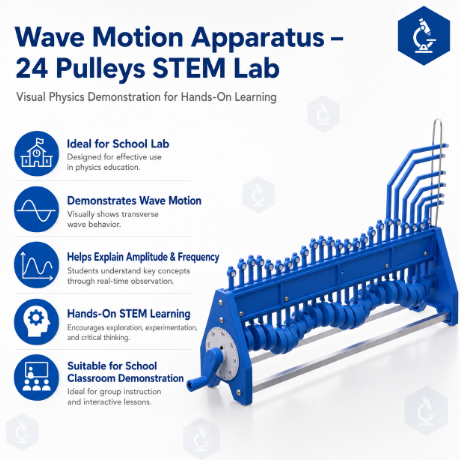
Product Code : SCL-EI-12545
Elevate your physics instruction to unprecedented clarity with the ultra-high resolution Wave Motion Apparatus (24 Pulleys) STEM Lab Kit, precision-crafted by Educational Instrument India. As a cornerstone instrument for demonstrating mechanical wave principles, this advanced model provides an exceptionally smooth, high-fidelity visualization of traveling transverse waves, perfectly translating complex partial differential mathematical wave functions into dynamic, real-world observations.
Unlike standard lower-resolution models, this apparatus features a robust steel crankshaft system supporting 24 masterfully synchronized eccentric pulleys/cams. Each cam is structurally offset from its adjacent counterpart at an engineered, uniform phase angle interval of 15 degrees. When the user rotates the manual low-friction hand crank, this precise mechanical matrix seamlessly translates angular displacement into coordinated vertical simple harmonic motion (SHM). A sequence of 24 lightweight, guided tracking rods with high-contrast, brightly colored spherical targets shifts vertically along the tracking grid, creating an uninterrupted, fluid sine wave propagation profile that sweeps horizontally across the length of the machine.
This heavy-duty apparatus is explicitly designed to fulfill rigorous requirements across secondary schools, specialized science academies, engineering institutions, and STEM research centers. By adding 6 additional tracking units compared to industrial baselines, it enables the simultaneous analysis of multiple wave intervals, complete phase cycles, and fine variations in amplitude or wave frequency.
Core Pedagogical and Technical Key Features:
Advanced 24-Pulley Matrix Architecture: Maximizes spatial resolution to deliver incredibly fluid and high-fidelity mechanical wave simulations, minimizing visual clipping.
Comprehensive Concept Tracking: Simplifies complex conceptual physics parameters, including wavelength , wave speed , amplitude , frequency , wave cycles, crests, troughs, and spatial phase transitions.
Industrial-Grade Structural Integrity: Constructed with a heavy-gauge steel base frame and reinforced vertical tracking grids to eliminate friction binding, reduce mechanical drift, and withstand demanding classroom lab environments.
High-Visibility Contrast Spheres: The vertical rods feature large, dual-color polymer indicator spheres, providing excellent visibility for live laboratory demonstrations in large lecture halls.
100% Interactivity: Completely mechanical gearless hand-crank operation allows students and educators to directly modify the input speed to visually witness the precise relationships governing periodic wave motion.
- Product Specifications
|
Parameter Matrix |
Technical Engineering Specification Details |
|
Brand Name |
Educational Instrument India |
|
Product Classification |
Advanced Mechanical Waves & Kinematics STEM Laboratory Kit |
|
Pulley Configuration |
24 Sequentially Precision-Offset Eccentric Cams (15° Phase Division) |
|
Drive Interface |
Ergonomic Manual Hand Crank supported by low-friction bearings |
|
Structural Base |
Heavy-duty, vibration-dampening powder-coated sheet metal framework |
|
Vertical Tracking Array |
24 Polished Rigid Steel Guide Rods with High-Visibility Polymer Spheres |
|
Wave Dynamics Simulated |
Continuous Traveling Mechanical Transverse Waves |
|
Dimensions (L x W x H) |
Approx. 580 mm x 130 mm x 320 mm |
|
Net Apparatus Weight |
Approx. 2.95 kg (Engineered for non-slip desk stabilization) |
- How to Use the 24-Pulley Wave Motion Apparatus
Ensure optimized laboratory instructional success by executing experiments according to these standard physics procedure methodologies:
Expert Lab Instruction Notice: Always place the apparatus on a level, stationary workbench. Before beginning your demonstration, rotate the hand crank one full rotation to verify that all 24 tracking rods slide freely without static friction or binding.
Baseline Calibration: Position the unit flat on the lab table. Manually check the alignment of the 24 indicator spheres. Ensure they align smoothly on the center horizontal axis when the crank is in its zero-state position.
Demonstrating Continuous Transverse Waves:
Slowly turn the hand crank in a consistent clockwise fashion.
Instruct students to trace the path of an individual sphere. Point out that the particle purely moves up and down vertically, while the wave profile travels horizontally across all 24 rods. This directly proves the physical definition of a transverse mechanical wave.
Quantifying Physical Wave Properties:
Halt the hand crank mid-cycle to freeze the wave form in place.
Have students use a standard meter stick or caliper to measure the horizontal distance from the 1st crest to the subsequent crest within the 24-rod structure. This quantifies the exact mechanical wavelength .
Measure the height from the central equilibrium axis to the peak of a crest to calculate the wave's peak amplitude
Analyzing Frequency & Phase Constant Shifts:
Increase the manual rotation rate of the crank. Show how increasing input speed yields a higher wave frequency while the physical structural wavelength remains mechanically constant due to the preset spatial cam spacing.
Have students track the sequential lag between adjacent rods to physically map the 15-degree mechanical phase shift across a 360-degree wave cycle.
- Frequently Asked Questions (FAQs)
Q1: What are the main benefits of choosing a 24-pulley apparatus over an 18-pulley version?
A: The 24-pulley model provides a much higher spatial resolution. The additional 6 tracking cams break down the wave phase cycles into narrower 15-degree increments (compared to 20-degree divisions in 18-pulley versions). This delivers a significantly smoother, more fluid visual wave projection, prevents visual clipping, and allows instructors to display a longer wave path or multiple complete wave cycles concurrently within a single frame.
Q2: Does this wave machine require any specialized long-term mechanical maintenance?
A: The 24 eccentric cams and tracking slot alignments are engineered to remain completely clean and oil-free to avoid staining laboratory workstations. To keep the machine operating smoothly over decades, simply apply a single drop of high-grade clear machine lubricant or thin silicone spray to the rotational bearings on the crankshaft once a year.
Q3: Can this apparatus demonstrate standing waves or constructive interference?
A: This mechanical pulley apparatus is configured with fixed-axis eccentric cams designed explicitly to simulate a continuous, forward-traveling transverse wave. To demonstrate wave interference or standing wave reflections, a flexible string driver or a premium helical wave slinky kit from Educational Instrument India would be the ideal companion lab item.
Q4: Are the vertical tracking rods safe from bending during student interaction?
A: Yes. The 24 tracking rods are engineered from specialized, high-tensile hardened rigid steel that resists bending under standard handling conditions. However, to maintain structural performance, users should avoid forcing the crank backwards or applying aggressive lateral pressure to the tracking columns.


.png)



.png)