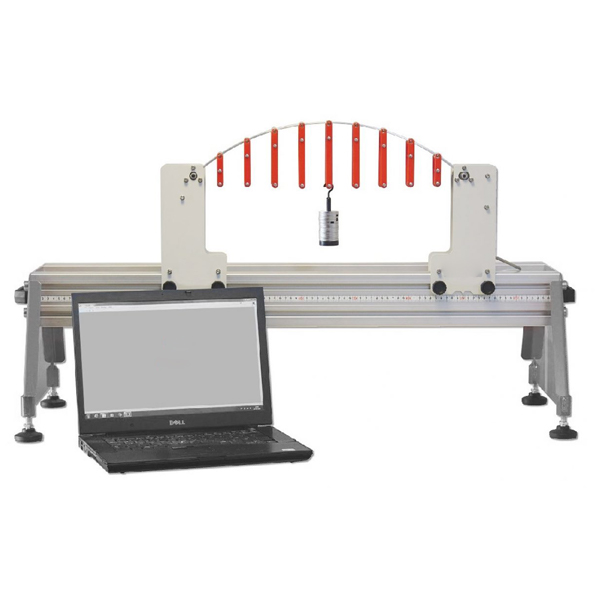
Quick Answer: The Two-Pinned Arch is a structures experiment in which one arch support acts as a roller and a load cell holds it in place while measuring the horizontal reaction caused by the load. Additional masses are included for a uniformly distributed load (UDL).
Last updated: October 2026
Key Features
One support allows translational movement, acting as a roller support
A load cell stops the translation and measures the horizontal reaction
Support pointers work with the platform scale for positioning
Additional masses apply a uniformly distributed load across the span
Point load and UDL results can be compared
Technical Specifications
Specification
Value
Supports
Pinned, with one acting as a roller
Reaction measurement
Load cell for the horizontal reaction
Loads
Single point load; additional masses for UDL
Positioning
Pointers with platform scale
About This Product
Students predict the reaction forces for a given load with textbook equations and check them against the measured horizontal thrust. They go on to draw influence lines and bending moment diagrams for the arch, and compare how it responds to a point load and a load spread across the span.
Frequently Asked Questions
How is the horizontal thrust of the arch measured?
One support can move sideways like a roller. A load cell prevents that movement and measures the horizontal reaction due to the load.