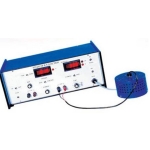
Quick Answer: The LED Characteristics Apparatus is used to plot the current-voltage curve of a light-emitting diode and find its knee voltage. It has a built-in variable 0 – 3V regulated DC supply with 0 – 3V and 0 – 50 mA meters.
Last updated: October 2026
Key Features
Built-in regulated DC supply, variable 0 – 3V
Supply rated 150 mA with short-circuit protection
Voltmeter 0 – 3V and milliammeter 0 – 50 mA
LED mounted on an insulated panel
4mm shrouded sockets for connections
Technical Specifications
Specification
Value
Power supply
DC regulated, variable 0 – 3V
Supply current
150 mA (short-circuit protected)
Voltmeter
0 – 3V
Ammeter
0 – 50 mA
Test component
LED on insulated panel
Terminals
4mm shrouded sockets
Dimensions
240mm x 200mm x 80mm (nominal)
About This Product
Students raise the voltage across the LED in small steps and note the current, then plot the I-V curve to see where the diode starts to conduct and light up. The experiment introduces forward bias and the knee voltage of semiconductor diodes in school and vocational physics.
Frequently Asked Questions
What does the LED characteristics experiment find?
It plots the I-V curve of the LED and finds the knee voltage at which it begins to conduct.

.png)

.png)
.png)