Solar Energy Kit with Lamp STEM Lab
Product Code : SCL-EI-12556
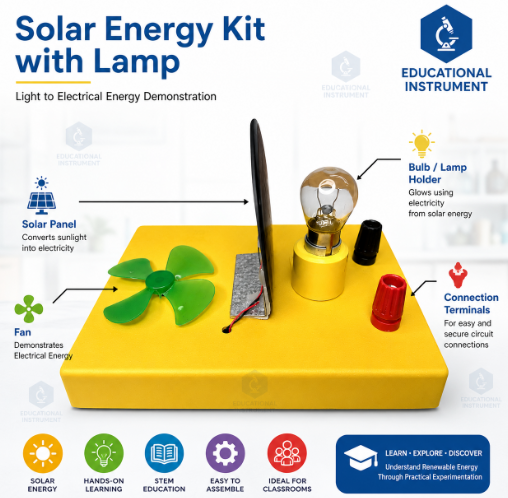
Introduce students to the mechanics of renewable technology, photovoltaic power generation, and green energy management systems with the premium Solar Energy Kit with Lamp STEM Lab Kit, meticulously manufactured by Educational Instrument India. Engineered to align with modern secondary physics practicals, environmental science modules, and advanced STEM training curriculums, this professional-grade kit transforms abstract semiconductor physics into clear, hands-on discoveries.
Instead of unreliable miniature hobby cells, this laboratory platform features a high-efficiency monocrystalline silicon solar panel housed in a rugged, angle-adjustable structural frame. The kit includes a calibrated, low-attenuation laboratory halogen heat lamp mounted on an adjustable gooseneck arm to serve as a reliable, repeatable simulated sun source. This layout enables instructors to conduct precise, predictable laboratory trials at any hour of the day, completely unaffected by outdoor weather changes or cloud cover. The primary console integrates a high-contrast monitoring panel featuring multi-scale digital or analog load tracking meters, a variable load potentiometer, a storage capacitor bank, and a series of interchangeable output loads like a mini DC motor, a sound buzzer, and high-intensity LEDs.
Perfect for middle schools, secondary academies, vocational training centers, and home-based engineering labs, this apparatus bridges the gap between textbook formulas and actual field performance. By adjusting the incident angle of the simulated sun lamp and tracking the resulting output, students can chart power curves, calculate photovoltaic efficiency ratings, and discover the core principles of sustainable power distribution systems.
Core Pedagogical and Technical Key Features:
Weather-Independent Solar Simulator: Outfitted with an industrial-grade, focusable 50W laboratory halogen heat lamp that provides a steady, high-intensity radiant energy spectrum inside any indoor classroom environment.
Premium Monocrystalline Silicon Panel: Utilizes a heavy-duty, protective-framed solar panel with integrated angle tilt markings to demonstrate how the cosine law of illumination alters output current.
Dual-Parameter Measurement Panel: Built-in dual multi-range digital or analog tracking voltmeters and ammeters give immediate, real-time feedback on circuit dynamics without needing external loose multimeters.
Multi-Load Output Array: Equipped with an array of functional energy sinks—including a miniature fan motor, an electronic buzzer, and a variable resistor matrix—to show how solar cells behave under different electrical load demands.
STEM Curriculum Integration: Fully optimized for charting Voltage-Current characteristic curves, calculating solar conversion efficiency, analyzing battery charging sequences, and understanding the inverse-square law of radiation.
- Product Specifications
|
Parameter Matrix |
Technical Engineering Specification Details |
|
Brand Name |
Educational Instrument India |
|
Product Classification |
Photovoltaics & Sustainable Energy Systems / STEM Lab Equipment |
|
Solar Panel Substrate |
High-efficiency Monocrystalline Silicon panel protected by tempered glass and an aluminum alloy frame |
|
Solar Panel Output Rating |
Peak Power : 3.0 Watts; Open-Circuit Voltage |
|
Simulated Light Source |
50W Calibrated laboratory radiant halogen sun lamp mounted on a flexible, heavy-duty adjustable gooseneck arm |
|
On-Board Test Meters |
1x Digital/Analog DC Voltmeter 1x; Digital/Analog DC Ammeter range) |
|
Load Matrix Modules |
1x Variable Potentiometer dial linear); 1x DC Hobby Motor with fan blade; 1x Piezoelectric Buzzer; 2x LED Array |
|
Energy Storage Block |
1x Built-in high-capacity Farad supercapacitor with an isolation toggle switch for energy storage tracking |
|
Chassis Platform Base |
High-impact, industrial-grade ABS structural console featuring a clear, screen-printed wiring schematic |
|
Assembled Dimensions |
Console Base: 320 mm times240 mm times 85 mm; Total Height with Lamp Extended: Approx. 450 mm |
|
Net Apparatus Weight |
Approx. 1.85 kg (Provides an ultra-stable footprint to prevent desktop tipping) |
- How to Use the Solar Energy Kit with Lamp
Ensure optimized laboratory instructional success and maximize experimental accuracy by adhering to these standard physics and engineering guidelines:
CRITICAL LABORATORY SAFETY NOTICE: The simulated sun lamp generates concentrated heat during extended runs. NEVER touch the glass bulb or the metal shroud of the lamp while it is turned on or immediately after use. Always let the lamp cool down completely for at least 10 minutes before storing the kit away.
System Positioning and Alignment: Place the core console onto a stable, level laboratory desk. Position the flexible gooseneck simulated lamp directly above the monocrystalline solar panel. Adjust the lamp height so the bulb faces down towards the panel surface at a distance of exactly 20 cm.
Initial Calibration and Open-Circuit Testing :
Plug the simulated lamp into a standard power outlet and turn it on. Set the tilt angle of the solar panel to exactly (so it is completely horizontal and perpendicular to the overhead light path).
Ensure all load toggle switches are flipped to the "OFF" position. Read the voltage display screen; this value is your Open-Circuit Voltage.
Analyzing the Voltage-Current Curve:
Flip the selector switch to route current through the variable potentiometer module. Connect the built-in voltmeter and ammeter into the circuit branch.
Turn the potentiometer dial slowly from its minimum resistance toward its maximum position. Have students log the changing voltage and current readings at 10 distinct intervals.
Instruct students to calculate the electrical power generated at each step using the photovoltaic power formula
Use this collected data to plot a standard solar cell characteristic curve, pinpointing the Maximum Power Point (MPP).
Demonstrating Alternative Energy Storage:
Disconnect the resistive loads and flip the energy routing switch to the storage capacitor module.
Have students use a stopwatch to track how fast the voltage across the supercapacitor rises, demonstrating how clean solar energy is stored for later mechanical use (such as running the DC fan motor after the sun lamp is turned off).
- Frequently Asked Questions (FAQs)
Q1: What is the benefit of using an included halogen lamp instead of conducting the experiments outdoors under real sunlight?
A: Conducting solar experiments outdoors introduces unpredictable environmental variables—such as passing clouds, shifting seasons, atmospheric haze, and varying geographic latitudes—which can alter your baseline data. The calibrated solar simulator lamp by Educational Instrument India provides a highly stable, controllable, and uniform radiant energy source. This enables student groups across different class periods to collect matching, reproducible, and verifiable scientific data indoors, day or night.
Q2: What is the operational difference between the monocrystalline solar panel used in this kit and cheaper polycrystalline alternatives?
A: Monocrystalline solar panels are cut from a single, high-purity silicon crystal structure. This uniform atomic path allows electrons to flow with minimal internal resistance, resulting in a significantly higher energy conversion efficiency ratin and superior performance under simulated artificial light compared to polycrystalline cells, which are made from melted fragments of silicon and have lower efficiency levels .
Q3: Why do the current ($I$) readings drop dramatically when the solar panel is tilted away from the light source?
A: This phenomenon demonstrates Lambert's Cosine Law of Illumination. The total solar irradiance hitting a specific surface area is maximized when the light rays strike it at a perfectly perpendicular angle . When you tilt the solar panel, the incoming beam of light spreads out across a larger surface area, reducing the operational energy density. Consequently, fewer photons strike the semiconductor layout per second, which reduces electron excitation and drops the total current output.
Q4: How should the solar panel surfaces be maintained to protect the kit's performance?
A: Dust layers, fingerprint oils, and surface smudges act as tiny physical barriers that block incoming light photons from reaching the underlying silicon layer, which can artificially lower your efficiency measurements. To clean the panel safely, unplug the device, apply a few drops of specialized optical lens cleaner or isopropyl alcohol to a soft, lint-free microfiber cloth, and gently wipe down the protective glass cover. Never use coarse paper towels or abrasive scrub brushes, as these can leave micro-scratches that permanently scatter incoming light rays.
.png)
.png)