Solar Water Heater Model STEM Lab

Solar Water Heater Model STEM Lab
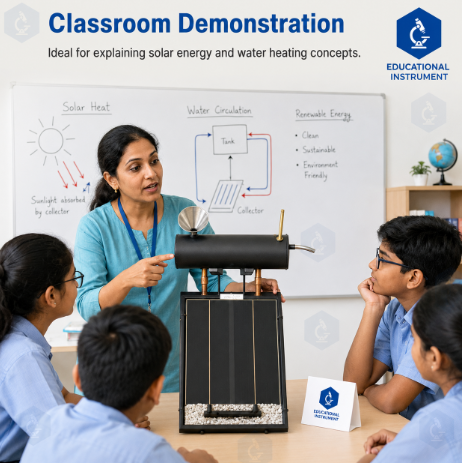
Product Code : SCL-MH-12537

Let’s be honest: reading about renewable energy in a textbook can feel a bit dry. Bring the power of green technology directly into the hands of your students with the Solar Water Heater Model STEM Lab manufactured by Educational Instrument India. Specifically engineered for science academies, tinkering labs, and physics departments, this fully functional tabletop working model serves as an excellent vehicle for exploring thermodynamics, fluid mechanics, and solar thermal energy conversion.

By demonstrating how radiant energy from the sun is captured, retained, and transferred into usable heat, this kit bridges the gap between theoretical calculations and practical environmental science. It is an indispensable addition to any modern laboratory committed to sustainable energy education.


Key Product Features

True Thermosiphon Demonstration: Visibly illustrates the passive thermosiphon effect, where water naturally circulates through the system via density differentials caused by thermal expansion—no electric pumps required!

High-Efficiency Absorber Plate: Features a selectively blackened aluminum absorber plate with embedded high-conductivity copper routing pipes, maximizing radiant absorption and minimizing reflective losses.

Insulated Thermal Storage Tank: Equipped with a dual-walled, polyurethane-insulated mini-storage tank that mimics industrial-scale systems to demonstrate effective heat retention.

Dual Temperature Tracking: Outfitted with specialized dual thermometer insertion ports at both the inlet collector and the insulated outlet tank, allowing students to map real-time thermal gradients.


Product Specifications

Parameter

Specification Details

Brand

Educational Instrument India

Product Name

Solar Water Heater Model STEM Lab

Collector Array Type

High-Acuity Flat Plate Collector

Absorber & Pipe Material

Selective Matt-Blackened Aluminum & Industrial Copper

Storage Tank Capacity

Approximately 1.5 Liters to 2.0 Liters

Circulation Mechanism

Passive Thermosiphon (Natural Convection)

Glazing Layer

High-transparency, shatterproof tempered acrylic sheet

Chassis & Stand

Corrosion-resistant powder-coated iron frame with adjustable incline

Included Measurement Tools

2x Precision Alcohol-in-Glass Thermometers

Target Educational Curricula

CBSE/ICSE Physics, AP Environmental Science, IB Diploma Design Tech


How to Use the Solar Water Heater Model

The apparatus is optimized for outdoor field trials under direct sunlight, but it can also be operated indoors using a high-intensity halogen lighting assembly.

Assemble and Calibrate the Incline: Set the apparatus on a stable surface. Adjust the tilt angle of the collector array so that it stands perpendicular to the incoming light source to optimize solar irradiance.

Prime the Thermal System: Connect the supplied silicone hoses securely between the collector plate and the storage tank. Fill the storage tank with cool distilled water using the provided funnel until the collector loop is entirely filled and free of air pockets.

Establish the Baseline: Insert the two thermometers into their respective ports—one at the lower inlet of the collector and one inside the upper storage reservoir. Record your initial ambient water temperature .

Expose to Radiation: Move the system into direct sunlight (or activate the artificial solar simulator lamp).

Track and Analyze Efficiency: Take systematic temperature readings every 5 minutes. Watch the hot water naturally ascend into the storage tank. Use the gathered data to compute the total thermal energy absorbed by the mass of the water using the fundamental thermodynamic formula:

Maintenance & Operational Note: To prevent scale buildup and internal oxidation within the copper pipes, always drain the water completely from both the tank and the collector after every experiment session. Store the unit in a dry environment and handle the acrylic glazing surface carefully to avoid scratches.


Frequently Asked Questions (FAQs)

Q1: What is the main physics principle demonstrated by this model?

This STEM apparatus primarily demonstrates solar thermal radiation absorption, conductive heat transfer, and convective fluid dynamics (the thermosiphon effect). It shows how water expands and becomes less dense when heated by the absorber plate, forcing it to naturally rise into the storage reservoir while cooler, denser water falls to replace it.

Q2: Can this model be utilized inside a laboratory without outdoor access?

Yes, absolutely. While natural solar irradiance provides the best real-world testing parameters, the kit is optimized to work efficiently indoors under a focused 500W to 1000W halogen studio lamp acting as a solar simulator.

Q3: Does this apparatus require any electrical connection or batteries?

No. The standard kit functions as a completely passive system, utilizing natural thermodynamic laws to circulate fluid. This pure mechanical framework gives students a clearer, unadulterated view of natural convection without the confounding variable of an electronic pump.

Q4: Is this equipment safe for middle and high school classrooms?

Yes, it is entirely safe. The system operates under safe atmospheric pressure (open venting), and the standard thermometers use non-toxic, tinted alcohol rather than mercury. However, water temperatures inside the collector can reach high levels under strong exposure, so standard lab safety and supervision are recommended during draining.

   
Supply of Solar Water Heater Model STEM Lab from to Finland, France, Tanzania, Thailand, Sri Lanka, Congo, Costa Rica, Ivory Coast, Croatia, Cuba, Cyprus, Czech Republic, Denmark, Djibouti, Dominica, Afghanistan, Albania, Algeria, Andorra, Angola, Antigua and Barbuda, Argentina, Armenia, Australia, Austria, Azerbaijan, Bahamas, Bahrain, Bangladesh, Barbados, United Arab Emirates (UAE, Dubai), United Kingdom (London), United States, Uruguay, Uzbekistan, Vanuatu, Belarus, Belgium, Belize, Benin, Bhutan, Bolivia, Bosnia and Herzegovina, Botswana, Brazil, Brunei, Bulgaria, Burkina Faso, Burma Myanmar, East Timor, Ecuador, Egypt, El Salvador, Equatorial Guinea, Eritrea, Estonia, Ethiopia (Addis Ababa), Fiji, Burundi, Cambodia, Cameroon, Canada, Cape Verde, Central African Republic, Chad, Chile, Colombia. Math Teaching Kit suppliers in Luxembourg, Macedonia, Madagascar, Malawi (Lilongwe), Malaysia (Kuala Lumpur), Maldives, Mali, Malta, Marshall Islands, Mauritania, Mexico, Micronesia, Moldova, Monaco, Mongolia, Montenegro, Morocco, Mozambique, Namibia, Comoros, Congo. Math Teaching Kit manufacturers in Dominican Republic, Gabon, Gambia, Georgia, Germany, Ghana, Greece, Grenada, Guatemala, Guinea, Guinea-Bissau, Guyana, Haiti, Honduras, Hungary, Iceland, Indonesia, Iran, Iraq, Niger, Nigeria (Abuja), Norway, Oman, Palau, Panama, Papua New Guinea, Paraguay, Peru, Philippines (Manila), Poland, Ireland, Israel, Italy, Jamaica, Japan, Jordan, Kazakhstan, Kenya (Nairobi), Kiribati, Korea, Kuwait, Kyrgyzstan, Laos, Latvia, Lebanon, Lesotho, Liberia, Liechtenstein, Lithuania, Mauritius, Nauru, Nepal, Netherlands, New Zealand, Nicaragua, Portugal, Qatar, Romania, Russia, Rwanda (Kigali). Math Teaching Kit exportets to Saint Kitts and Nevis, Saint Lucia, Saint Vincent and the Grenadines, Samoa, San Marino, Sao Tome and Principe, Saudi Arabia, Senegal, Serbia, Seychelles, Sierra Leone, Singapore, Slovakia, Slovenia, Solomon Islands, Somalia, South Africa, South Sudan, Spain, Sudan, Suriname, Swaziland, Sweden, Switzerland, Syria, Tajikistan, Togo, Tonga, Trinidad and Tobago, Tunisia, Turkey, Turkmenistan, Tuvalu, Uganda (Kampala), Ukraine, Venezuela, Vietnam, Yemen , Zambia (Lusaka), Zimbabwe

Office Address

Works:750, Industrial Estate, Sonawala Cross Road No.2,
Goregaon, Mumbai, Maharashtra 400063

[email protected]

Follow Us